Plug-in solar: what all the fuss is about.
A solar panel you buy in a box, stand in the garden, lean against the fence, and plug into an ordinary socket. Half of Europe has been doing it for years, the government has decided Britain should join in, and from 27 August it's legal here too. In the right setup, it's the cheapest way into green savings this country has ever offered. Worth five open-minded minutes.
All of this has to be true. Miss one and you are outside the rules, whatever the seller says.
- – 800 W maximum AC output in the regulations themselves (SI 2026/848, made 16 July 2026, in force 27 August 2026), and 800 VA apparent power with a 3.5 A maximum current in the government's Interim Product Specification. A product datasheet may quote either, so check for both. The cap is on what the inverter puts out, not on the panels behind it.
- – Complete factory-built kits only, and no battery in the box. Self-assembled combinations and battery bundles are outside the regime.
- – A moulded BS 1363 plug – the standard British three-pin, fitted at the factory. No adapters, no rewired ends, no extension leads.
- – The kit must be listed on the ENA register of approved products, as compliant rather than merely submitted.
- – You must notify your Distribution Network Operator under Engineering Recommendation G98, for connection and for disconnection. It is a form, not a fee, and it is not optional. Deadlines are set by your network operator, so check the one your DNO states.
- – Great Britain only. The regulations that legalised plug-in solar extend to Great Britain, and the government has said applying the product specification to Northern Ireland needs further consideration, with a separate engineering recommendation applying there. So: legal in Great Britain, not yet settled in Northern Ireland.
Germany has more than 1.2 million of these hanging off balconies, and their supermarkets sell the kits next to the garden furniture. The appeal is the missing middleman: no installer, no scaffolding, no survey, no five-figure quote. A box, an afternoon, a socket. The government likes it because 45GW of solar by 2030 needs every roof, rail and fence it can get – and because a product Lidl and Iceland can stock reaches households a solar salesman never will. Yes, that Iceland. The fuss, in short: solar without the ceremony.
This route exists for everyone the rooftop route was never built for. Renters – the kit is yours and moves with you, landlord's nod needed for fixings. Flats with a decent-sized balcony – freestanding frames today, hanging kits and clearer planning rules still to come. Listed buildings and conservation areas, where roof panels mean a planning saga but a kit leaning in the garden usually doesn't. Homes with a north-facing roof and a south-facing fence. And anyone with £500 to £900 to hand but no appetite for £6,500. If rooftop solar's economics were a members' club, this is the door being propped open.
The law allows up to 2,000W of panels feeding an inverter capped at 800W. In actual objects: a standard panel is about 450W and roughly the size of a door lying on its side – 1.7 metres by 1.1. So a legal kit is one to four panels; the first kits listed as compliant as of 26 August 2026 were one-panel and two-panel affairs. Picture a door or two leaning against the fence at an angle, or standing on frames on the patio, with a lead running to an outdoor socket. The 800W cap is the whole design: small enough to be safe on an ordinary circuit, big enough to run the fridge, the router, the laptops and the general daytime hum of a house.
Germany's word for these is Balkonkraftwerk – balcony power plant – so you'd be forgiven for planning exactly that. Hold on. The government's own impact assessment says planning permission for balcony and wall mounting is 'uncertain': fixed panels only count as permitted development if they stick out less than 20cm, which means hanging them nearly vertical and losing a chunk of the output. As of 26 August 2026, the first kits listed as compliant were ground-mount only – UKSOL's were listed with an actual 'not suitable for balconies' label, and at 25kg a panel you can see their point. So day one in Britain is gardens, fences, patios and shed roofs. Hanging kits and clearer planning rules should follow – but if the balcony is your only option, this route says 'not quite yet' rather than 'yes'. Worth knowing how the Germans actually do it, though: panel hung on the balcony rail, flat lead through the window seal, plugged into an ordinary indoor socket – millions of them, entirely unremarkable. Britain's rules may well relax in that direction once the market beds in. They just haven't yet, and this page deals in 'is', not 'ought'.
The kit feeds whatever's switched on. Kettle boiling? The kit chips in. Nothing much on? The surplus doesn't vanish – it flows out through your meter into the street's wires, where it becomes the cheapest electricity your neighbours never knew they were getting. Physically it's exported; financially you're not paid – export payment schemes require certification these kits don't carry, though the government says it's exploring changing that. So yes: your spare units genuinely make the neighbourhood a touch greener, free of charge, with no paperwork and no thanks. Which is why the whole game is using the power yourself while the sun's out – and why our quiz asks who's home in the day.
Just about – and carefully. As of 26 August 2026, the first kits listed as compliant came from UKSOL, a British company that assembles its kits in Sheffield: a 460W single-panel ground kit observed at £849 and an 890W two-panel kit observed at £1,199 (both prices as listed on 26 August 2026, including delivery), listed as on sale from 27 August in limited stock as of 26 August 2026. Cheaper hybrid wall-mount kits were listed as expected from October, from £499, as of 26 August 2026. The register changes, so check it before you buy rather than taking a list here on trust.
The check before you buy: the ENA Connect Direct Type Test Register is public and needs no login – search for it, filter to plug-in solar, and the kit you're buying must be listed as 'Compliant', not merely submitted. Anyone selling a 'fully approved' kit that isn't on that list is ahead of the facts.
The plug-in kits easiest to buy in Britain right now – battery-equipped 'balcony power station' bundles from around £799 – are OUTSIDE this law entirely. The new rules cover solar-only kits: no batteries, factory-fitted UK plug, no extension leads, no adapters. A battery in the box means the socket route does not apply to it.
The government's own modelling says a south-facing tilted kit generates around 690kWh a year and saves roughly £110; a vertical balcony-rail mounting is nearer £70. Our engine uses the same DESNZ generation and self-consumption figures, so that agreement is arithmetic rather than a second opinion. The independent check is the Energy Saving Trust's £69 to £97. That's £69 a year if you're out all day and £97 if you're home – their occupancy split, incidentally, being exactly the lever our checker asks you about. You'll see higher numbers in the press and lower ones from sceptics (some analysts assume less of the output gets used and land at £40–85). The truthful summary: a modest, real saving that depends almost entirely on whether someone's home in daylight to use the power.
Semi-detached, south roof, average region, 2,500 kWh a year (the Ofgem typical value)
Import 26.11p/kWh (Ofgem cap Jul-Sep 2026, GB average direct debit, including VAT at 5%). Export shown as a pair: 6p if you do not switch supplier, 12p if you do. Export rates are supplier-set, not regulated, and the underlying data covers April 2024 to March 2025 – Ofgem Smart Export Guarantee Annual Report, Year 5 (published December 2025). Constants v0.6.0, 2026-09-19.
£500 is the government's estimate of what kits will cost once this market reaches scale, and it's the number our engine models. The first kits listed as compliant as of 26 August 2026 landed above that – £849 at launch, in limited stock – which is what day one of a new market looks like. For where it goes next, look at Germany: at volume, supermarket kits sell there from around €199, with Lidl shifting them off the shelf next to the bratwurst. Legal now – but supply, retail range and price discovery all need to come good over the next few months. If you're not in a hurry, waiting a quarter will likely be rewarded.
- –One kit per household, capped at 800W of inverter output in the regulations – 800 VA apparent power and 3.5A maximum current in the government's product specification – with up to 2,000W of panel behind it.
- –It must have a factory-fitted UK plug, into an outdoor socket (IP55-rated or better). Extension leads, adapters, and cables trailed through windows are all out here – if you don't have an outdoor socket, an electrician can fit one for a modest sum. (Germany runs millions of these through flat window leads; Britain's spec may loosen that way in time, but today it's outdoor socket or nothing.)
- –No batteries in the kit – battery systems are excluded from this law, and the rules for them are expected to follow later.
- –One notification form to your electricity network operator. A form, not a fee. Your network operator sets the deadline, so check theirs.
- –No export payments: without an MCS certificate there's no smart export guarantee, so anything you don't use is given away.
- –Renters: you'll need the landlord's nod for fixings – but the kit is yours and moves with you.
- –Already have rooftop solar? Adding a kit can push your home over the simple-connection limit and trigger a formal application to your network operator first – a process, not a purchase.
Observed on 26 August 2026 and not re-checked since. The approved-product register changes weekly – check it rather than this page before you buy.
Lidl, Iceland (retail) and EcoFlow (manufacturing) – working with government, with nothing listed as certified under their names as of 26 August 2026.
Amazon, Asda, B&Q, Currys, Screwfix and Wickes – preparing to stock, with no products or prices listed as confirmed as of 26 August 2026.
UKSOL, Sheffield – whose kits were listed as 'Compliant' on the register as of 26 August 2026. Argos was listed as selling UKSOL's kits from launch day itself as of 26 August 2026 (Bloomberg, 27 Aug); Currys was listed as following, with Amazon supplied via the family's own retailer, Crampton & Moore, as of 26 August 2026.
The government has earmarked up to £25m of Warm Homes Plan money for plug-in solar – but read the small print before celebrating: it's a pilot delivered through councils and metro mayors, aimed at low-income households street by street. There is no application form, and no scheme design has even been published yet. What you CAN access today: the Warm Homes Local Grant through your council if you're on a lower income, ECO4 until December 2026, and low-interest solar loans arriving from 2027. For the flavour of where the pilot is headed, the government filmed a London street taking control of its own energy supply – it's in the watch list below.
Germany is the existence proof: about 1.3 million registered plug-in systems, supermarket price wars, and a boring, functioning market. The Netherlands is the counter-example – its wiring standard requires a dedicated circuit, its cabinet declined to promote plug-in solar as recently as July 2026, and adoption is near zero. Flanders, meanwhile, legalised plug-in solar and batteries together in 2025. Britain has chosen the German road with British paperwork. One warning for your reading: the '400,000 kits in France' figure that circulates online is unsourced – the French industry's own barometer marks that market 'not measured'. We don't use it, and nor should anyone else.
Five electrical safety bodies issued a joint statement in June urging caution, and Electrical Safety First advises buying from reputable high-street retailers rather than marketplace listings – advice we'd underline twice. Two engineering notes worth the candle: the law doesn't require an electrician, but the safety bodies recommend a wiring check (upwards of £150) for older homes before plugging in – British sockets have spent their whole lives sending power one way, and this is the first product to send it back. And ask your electrician whether your RCDs – the trip switches in the fuse box – are bidirectional; older ones aren't designed for reverse flow. Belt, braces, and a quieter conscience. Marketplace 'energy-saving' plug scams are a documented problem, and non-compliant overseas kits will not vanish from listings on 27 August. The boring, correct routine: check the register, buy a kit listed as compliant from a real retailer, plug it into its own socket (never an extension lead), and send the network operator form. That's the whole ritual.
Yes – that's the entire point. From 27 August, a certified kit needs no electrician. An afternoon, a spanner, an outdoor socket, and the notification form. For older wiring, a one-off electrician check first is the safety bodies' recommendation – not the law, but cheap peace of mind.
Renters and leaseholders need consent for fixings. Everyone sends one notification form to their network operator. Nobody needs planning permission for a compliant kit at ground or balcony level in normal cases.
It will work; it won't work hard. Orientation can halve the output. Our checker accounts for exactly this.
Output drops steeply – most of the year's value arrives between March and October. The £110 figure already averages this.
At the £849 observed at launch on 26 August 2026, and at today's electricity prices the payback is roughly seven to eight years against a 20–25-year panel life – defensible, not thrilling. If certified prices track the government's £500 at-scale estimate, it improves markedly. Waiting a few months costs you one autumn of modest generation.
Not under this law – solar-only. Battery rules are expected to follow; buying a battery-bundled kit today puts you outside the regime entirely.
It switches itself off, instantly – a safety feature, not a flaw. A plug-in kit is a contribution to your bills, not a backup supply. If blackout resilience is what you're after, that's a battery conversation.
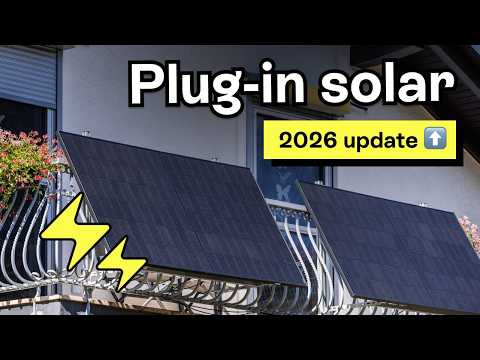
The worth-it question, answered (made by a company that sells this kit, so watch it with that in mind).
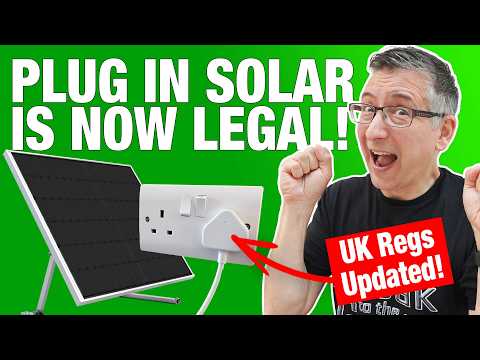
The law change, enthusiastically decoded.
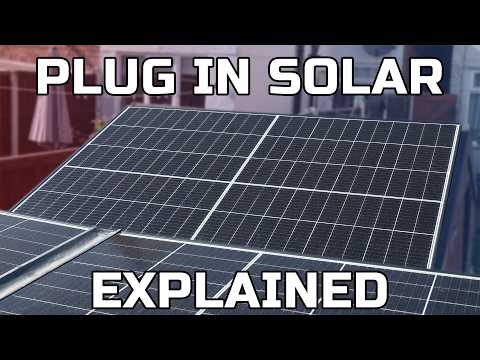
Pros, cons, and the hardware reality.

The Germans, generously sharing a decade of homework.
The £25m street-by-street vision, filmed.
Launch-day feature from inside UKSOL's Sheffield operation (paywalled).
The pre-launch expectations piece – compare it with what actually arrived (paywalled).
The official announcement and roundtable readout.
The actual law, shorter than you'd fear.
The best mainstream explainer so far.
Would a kit actually earn its keep at your place? Three minutes, honest answer.
Check my options →